
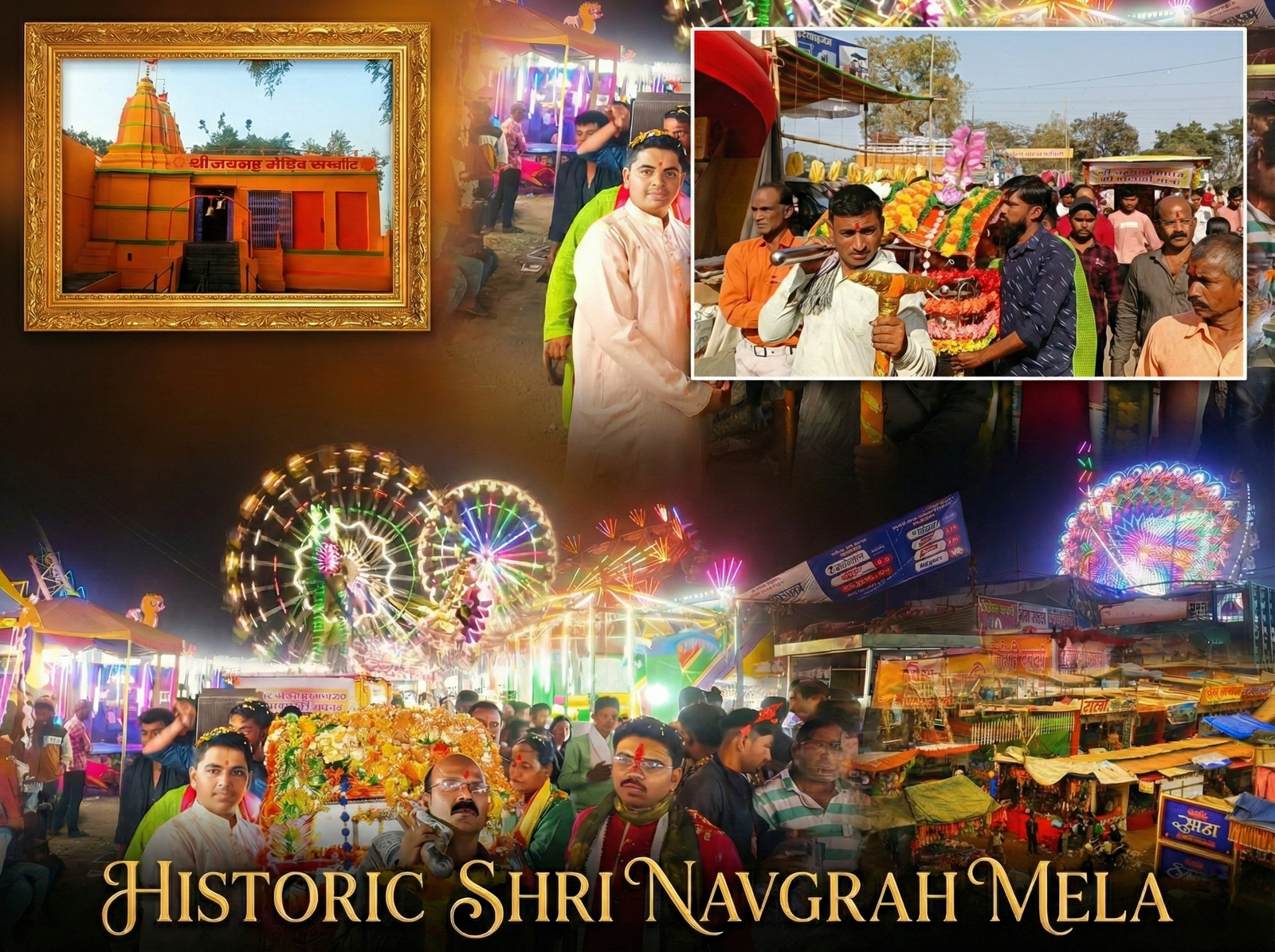
The city of Khargone, known reverently as the City of Navgrahas, is home to one of India’s most ancient and spiritually significant temples—Shri Navgrah Mandir. With its profound astrological lineage, the divine presence of Mata Baglamukhi, and centuries-old rituals of Navgraha Shanti, this temple has given birth to one of Madhya Pradesh’s grandest cultural and religious events:
The Historic Shri Navgrah Mela.
For generations, this iconic fair has been celebrated with devotion, joy, and a deep sense of tradition. Locally, the mela is lovingly known as “Shri Navgrah Maharaj ki Jatra.” It is not just a gathering—it is the living heartbeat of Khargone’s spiritual identity.
Origins of Shri Navgrah Mandir: A Temple Born Under Divine Guidance
Shri Navgrah Mandir was founded on Makar Sankranti in Shaka Samvat 1700 by the ancestor of the current priestly lineage, Shri Shesh Baba (Sheshappa) Sukhavadhani. He constructed the temple and installed all deities according to the classical South Indian tradition of idol consecration (Prana Pratishtha).
The temple stands firmly on the foundation of the sacred shloka:
“Brahma Murāri Tripurāntakāri
Bhānuḥ Śaśi Bhūmisuto Budhaśca ।
Guruśca Śukraḥ Śani Rāhu Ketavaḥ
Sarve Grahāḥ Śānti Karā Bhavantu ॥”
In alignment with this mantra:
-
Mata Saraswati represents Brahma
-
Pattabhirama represents Murari
-
Shri Panchmukhi Mahadev represents Tripurantakari
-
And in the sanctum, the nine planetary deities (Navgrahas) reside in their full glory.
With Mata Baglamukhi also enshrined here, the temple is revered as the Peetambara Graha Shanti Peeth, a powerful centre for planetary remedies and protection.
Why Khargone is Called the “City of Navgrahas”
In Khargone, the Navgrahas are worshipped as the protecting deities of the city, fondly addressed as Navgrah Maharaj. This unique cultural reverence is the reason the annual fair is known as:
“Shri Navgrah Maharaj ki Jatra”
Historical Evolution of the Shri Navgrah Mela Khargone
According to Acharya Lokesh D. Jagirdar(Vairagkar), the sixth-generation descendant of the temple’s founder, the mela began around 1878 during the Kartika month and was initially small in size. Local jagirdars administered these fairs.
The shops, food stalls, and village markets were organised around the temple and along the banks of the River Kunda, where the vibrant fair would flourish each year.
The Royal Connection: How a King’s Healing Started a Tradition
A significant turning point in the mela’s history arose from the royal family of Holkar State.
During the late 19th century,
Maharaja Shivajirao Holkar suffered from severe mental distress and affliction.
Following the guidance of royal physicians, a Navgraha Shanti and Baglamukhi Anushthan was performed at Shri Navgrah Mandir by Pt. Tukaram Krishnam Vairagkar(Jagirdar), the third-generation descendant of the temple founder.
By divine grace, the Maharaja completely recovered. Deeply grateful, he personally visited Khargone and, recognising the spiritual power of the temple and the auspiciousness of Makar Sankranti, he:
Formally inaugurated the Shri Navgrah Mela on Margashirsha Purnima, 1887
And set its duration from Margashirsha Purnima to Paush Purnima—a full month.
To this day, this remains one of the most important milestones in the mela’s history.
The Grand Palanquin Procession (Palkhi Yatra)
Since 1887, an essential tradition of the mela has been the:
Palkhi Yatra of Shri Navgrah Maharaj
Held on the final Thursday of the fair.
The procession begins at the temple, travels through the major pathways of the mela, and returns to the temple premises—a divine spectacle that draws thousands of devotees.
From Ancient Grounds to Organised Fairgrounds
Over time, the administration of the mela shifted:
- Shri Navgrah Yatra(Jatra) began in 1878 as a small Kartik fair set up by local villagers near the Navgrah Mandir.
-
The Holkar State first formally organised it in 1887.
-
Later, the village panchayat took over
-
From 1952 onward, the Nagar Panchayat organised it
-
After drought restrictions and historical interruptions (1952, 1965–66, 1992–93), the mela eventually found stability
-
Since 1967, it has been managed at the designated Mela Ground by the Khargone Municipal Council(Nagar Palika Parishad Khargone)
-
During the COVID years 2021 & 2022, the mela was held for a shorter duration, preserving tradition despite challenges
Today, the mela continues under the auspices of the municipal authority and is celebrated annually from January to February for 45 days.
The Second Largest Fair of Madhya Pradesh
As per Acharya Lokesh Jagirdar, the Shri Navgrah Mela enjoys state-level recognition and is considered:
Madhya Pradesh’s second-largest fair
It is also famous as the largest cattle fair in the state.
More than 400+ shops and stalls are set up every year, featuring:
-
Traditional bazaar stalls
-
Food courts & sweet shops
-
Handicrafts & jewellery stores
-
Circus shows
-
Amusement rides
-
“Maut ka Kuan”
-
Games, toys, cultural attractions
-
Numerous entertainment activities for families
People from villages, towns, and nearby districts eagerly wait every year to visit the mela.
The Mela & Makar Sankranti – A Devotee’s Sentiment
Traditionally, the mela reaches its peak during Makar Sankranti, the biggest festival of Shri Navgrah Mandir. Devotees from across Madhya Pradesh and other parts of the country visited the temple for:
-
Surya Darshan
-
Navgraha Shanti Puja
-
Baglamukhi Upasana
-
Griha Shanti rituals
However, since the mela dates now follow the calendar instead of traditional tithis, many devotees feel nostalgic, as Sankranti no longer aligns perfectly with the mela’s peak.
Still, the spirit remains unbroken—devotees participate wholeheartedly, preserving the essence of this centuries-old celebration.
A Living Heritage of Faith
The Shri Navgrah Mela is more than a fair—it is:
-
A chronicle of Khargone’s ancient heritage
-
A symbol of the city’s devotion to the Navgrahas
-
A timeless tradition that has survived wars, droughts, and pandemics
-
A celebration that unites people of all ages, communities, and regions
With its blend of spirituality, history, culture, and community joy,
The Shri Navgrah Mela stands today as one of India’s most vibrant and sacred annual traditions.
FAQ
❓ What is the Shri Navgrah Mela of Khargone?
The Shri Navgrah Mela of Khargone is a historic religious and cultural fair held annually in honour of Navgrah Maharaj, centred around the ancient Shri Navgrah Mandir. It is one of the largest fairs in Madhya Pradesh and holds deep astrological and spiritual significance.
❓ Why is Khargone called the City of Navgrahas?
Khargone is known as the City of Navgrahas because the Navgrah deities are worshipped here as the city’s presiding gods. The annual Navgrah Mela and continuous Navgrah Shanti rituals have established this unique identity.
❓ When did the Shri Navgrah Mela begin?
The Shri Navgrah Mela began in 1878, initially as a small local fair. It received formal royal recognition in 1887 when Maharaja Shivajirao Holkar inaugurated it on Margashirsha Purnima.
❓ What is Navgrah Maharaj ki Jatra?
Navgrah Maharaj ki Jatra(Yatra) refers to the traditional name of the Shri Navgrah Mela. It highlights the belief that Navgrah Devtas are royal protectors of Khargone and are honoured through this grand annual procession and fair.
❓ What is the Palakhi Yatra of Shri Navgrah Maharaj?
The Palakhi Yatra is a sacred procession conducted on the final Thursday of the mela, where Navgrah Maharaj’s palanquin is carried through the main routes of the fair and returns to the temple.
❓ Why is Mata Baglamukhi worship important in Shri Navgrah Mandir?
Mata Baglamukhi is worshipped here as Pitambara Devi, making the temple a powerful Pitambara Graha Shanti Peeth. Her worship is believed to neutralise planetary afflictions and negative influences.
❓ How long does the Shri Navgrah Mela last today?
Currently, the Shri Navgrah Mela is organised for 45 days, usually during January–February, under the administration of the Khargone Municipal Council.
❓ Why is Shri Navgrah Mela famous across Madhya Pradesh?
The mela is famous for being:
-
The second-largest fair in Madhya Pradesh
-
The largest cattle fair in the state
-
A blend of religion, astrology, trade, and entertainment