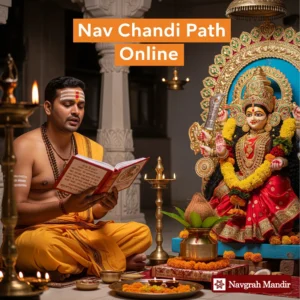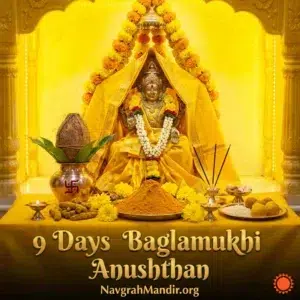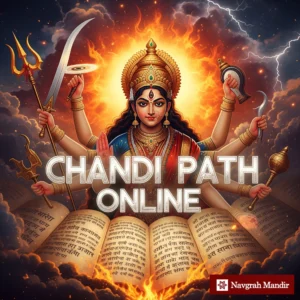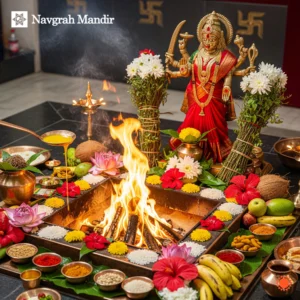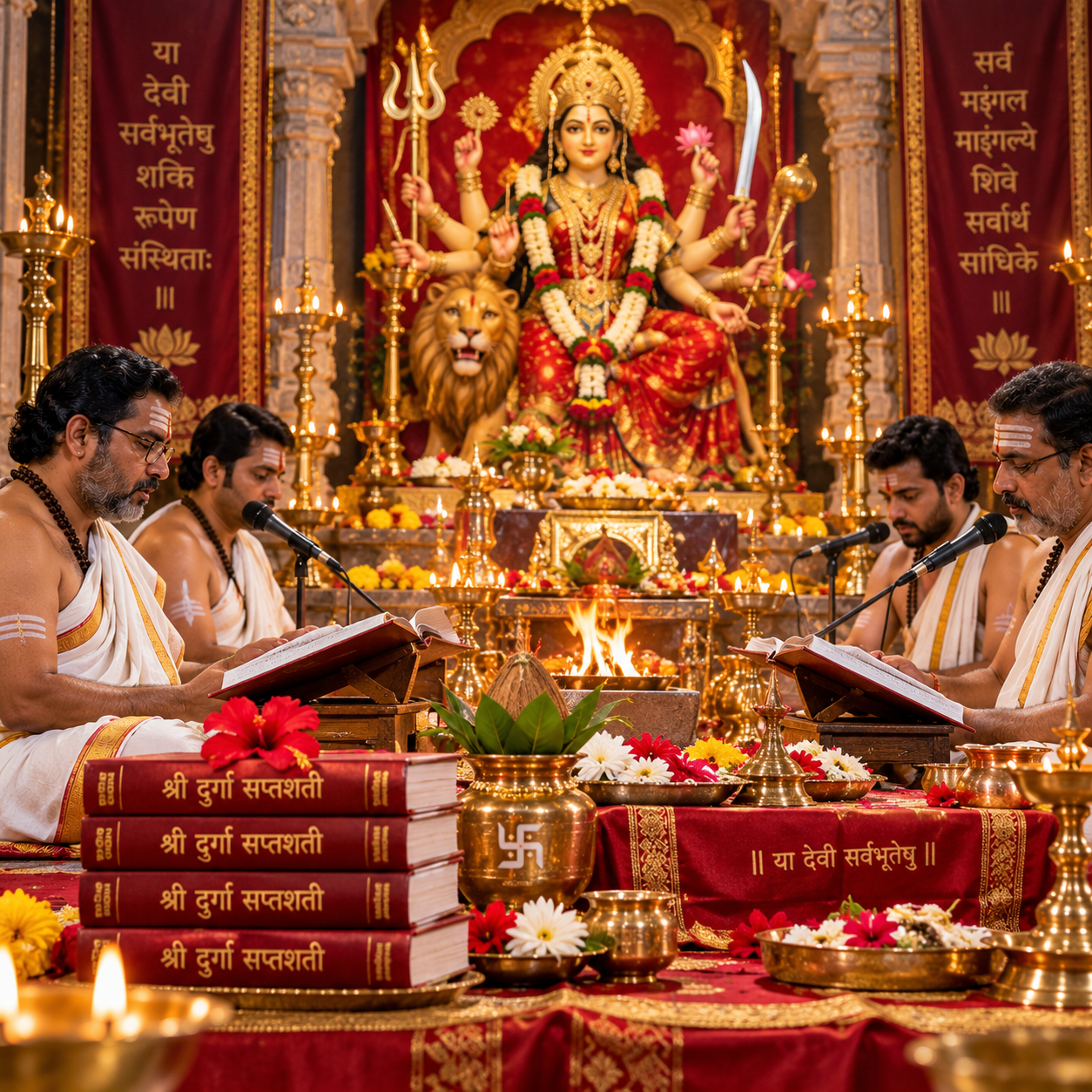
A Durga Saptashati Anushthan is a disciplined nine-day recitation of the Durga Saptashati, performed as a continuous spiritual undertaking rather than a single reading, and concluded with a yagya and purnahuti on the final day.
At Shree Navgrah Mandir in Khargone, Madhya Pradesh, this anushthan is performed by Acharya Lokesh Jagirdar and his team on behalf of the devotee. You take part in the sankalp yourself over a live video call at the start, and again in the ashirwad puja, yagya and purnahuti on the ninth day — wherever in the world you are.
What Is Durga Saptashati Anushthan?
Durga Saptashati is a text of seven hundred verses arranged in thirteen chapters, drawn from the Markandeya Purana. It is also known as Devi Mahatmya and, in common usage, as Chandi Path. The verses narrate the Devi’s manifestations and her victories over Mahishasura, Shumbha and Nishumbha, and the text is foundational to the Shakta tradition.
An anushthan is different from a path.
A path is a recitation of the text. An anushthan is a sustained ritual undertaking carried out over a fixed number of days under defined discipline, with a formal sankalp at the beginning and a concluding fire ritual at the end. The recitation sits inside a larger structure.
At Shree Navgrah Mandir, the Durga Saptashati Anushthan runs for nine days and concludes with yagya and purnahuti on the final day.
Traditional Significance
Within the Shakta tradition, the Durga Saptashati is regarded as one of the principal texts for the worship of the Devi. According to traditional practice, the text is read with a sankalp — a stated intention — and the recitation is understood as an offering made with that intention held throughout.
Navratri is traditionally considered the most auspicious period for recitation of the Saptashati. Outside Navratri, Tuesdays and Fridays, and the Ashtami, Navami and Chaturdashi tithis, are traditionally regarded as suitable days to begin.
The nine-day form carries a natural correspondence with the nine nights of Navratri and the nine forms of the Devi, which is why an anushthan is traditionally undertaken across nine days rather than compressed into fewer.
Why Is a Durga Saptashati Anushthan Performed?
Devotees traditionally undertake this anushthan seeking the Devi’s protection and grace. Within tradition, it is associated with:
- Protection from negative influences and inauspicious circumstances
- Courage, strength and steadiness during difficult periods
- Peace and harmony within the household
- Spiritual merit and the fulfilment of a sincerely held sankalp
These are traditional associations, not assurances of outcome. Shree Navgrah Mandir does not promise any specific worldly, financial, legal or medical result from the performance of any ritual, and no ritual should be treated as a substitute for medical treatment or professional advice.
Who May Consider This Anushthan?
This anushthan may be appropriate for a devotee who:
- Wishes to undertake a complete nine-day Saptashati observance but cannot perform it personally
- Is observing Navratri and wants the full anushthan performed with proper vidhi at a temple
- Has a specific sankalp they wish to place before the Devi through a sustained observance
- Lives outside India and wants a ritual performed in an established temple in their family tradition
- Wants something more substantial than a single-day path
If you are unsure whether the anushthan or a shorter observance suits your situation, contact the temple before booking. Acharya ji will advise you honestly, including advising against it where something simpler is more appropriate.
When Is It Performed?
The anushthan may be undertaken at any time of year. Navratri — both Chaitra and Shardiya — is traditionally regarded as the most auspicious period, and demand is heaviest then.
Because the observance runs nine days, booking ahead matters. For Navratri anushthans in particular, contact the temple well in advance so the start date aligns correctly with the ghatasthapana and the observance completes on the appropriate tithi.
For anushthans outside Navratri, the start date is fixed in consultation with Acharya ji after booking.
How Is the Anushthan Performed?
The anushthan follows this sequence at Shree Navgrah Mandir:
- Sankalp — On the opening day, the sankalp is performed with your name, gotra and stated intention. You participate in this live over a video call.
- Recitation — The complete Durga Saptashati is recited across the nine days by Acharya Lokesh Jagirdar and his team, following the traditional division of the text.
- Daily observance — The recitation is carried out each day at the temple under the discipline appropriate to an anushthan.
- Yagya and purnahuti — On the ninth day, the observance concludes with the yagya and the final purnahuti offering.
- Ashirwad puja — Also on the ninth day, the ashirwad puja is performed, with you participating live.
Ritual procedure varies between traditions and lineages. The sequence above reflects the practice followed at Shree Navgrah Mandir, which belongs to a family lineage that has served this temple for more than 230 years.
Note on samput: This anushthan is performed as a standard Saptashati anushthan. Samputit path — recitation with a beej mantra interposed between verses — is a separate practice and is not included here. If a provider offers samput, ask them specifically what it involves before comparing prices.
What Is Included
| Duration | Nine days |
| Concluding ritual | Yagya and purnahuti on the ninth day |
| Live participation | Sankalp puja and ashirwad puja with yagya and purnahuti |
| Recordings | Video clips and photographs of the Sankalp Puja |
| Performed by | Acharya Lokesh Jagirdar and his team |
| Location | Shree Navgrah Mandir, Khargone, Madhya Pradesh |
| Dakshina | ₹26,000 |
| Prasad dispatch | Optional add-on, charged separately |
Participating Online from Anywhere
You do not need to travel to Khargone. The anushthan is performed at the temple on your behalf, and you take part at the two moments where your presence matters most.
The sankalp is where your intention is formally placed before the Devi. This is conducted live over WhatsApp video call, or another video platform if you prefer, so you are present as your name, gotra and sankalp are spoken.
The ashirwad puja on the ninth day, including the yagya and purnahuti, is also conducted live with you present.
Between these two points, the daily recitation proceeds at the temple. You receive video clips and photographs of the sankalp puja for your records.
This arrangement suits devotees across India and those settled abroad, where time zones and travel make physical attendance impractical.
Sankalp and Personalisation
Every anushthan at Shree Navgrah Mandir is performed with a personal sankalp. It is not a generic recitation.
After you book, the temple contacts you over WhatsApp to collect the details needed for the sankalp — the name or names of the devotees, gotra, and the intention with which you wish the anushthan to be performed. If you do not know your gotra, Acharya ji will guide you on what to do; this is a common question, and there is a traditional answer for it.
These details are used solely for the performance of the ritual. The temple does not publish or share devotee details.
How to Book
- Book directly on this page. Payment can be completed online, and the payment options support both Indian and international cards.
- If you would rather not pay through the website, message the temple on WhatsApp and payment details will be shared with you directly.
- After booking, the temple contacts you on WhatsApp to collect your sankalp details and to fix the start date.
- You join the live sankalp on the opening day.
- You join the live ashirwad puja, yagya and purnahuti on the ninth day.
- If you have chosen prasad dispatch, it is arranged after the anushthan concludes.
Dakshina: ₹26,000. Prasad dispatch is optional and charged separately.
Why Shree Navgrah Mandir
A temple, not a marketplace. The anushthan is performed at Shree Navgrah Mandir in Khargone — an actual temple with an actual priest, not a booking platform that assigns whichever pandit is free.
A lineage that has served this temple for more than 230 years. Acharya Lokesh Jagirdar is the sixth-generation priest of Shree Navgrah Mandir, a temple his family founded. He has practised Vedic astrology and karmakand for more than 26 years.
You are present for the sankalp. Your intention is placed before the Devi with you watching, not relayed to you afterwards.
Stated scope, stated dakshina. Nine days, concluding yagya and purnahuti, ₹26,000. No tiered upsells introduced after you have committed.
Honest about what is not included. Samput is not part of this anushthan, and we say so on the page rather than leaving you to discover it later.
Frequently Asked Questions
What is the difference between a Durga Saptashati Path and a Durga Saptashati Anushthan? A path is a recitation of the text, often completed in a single day. An anushthan is a sustained observance over a fixed number of days with a formal sankalp at the start and a concluding fire ritual. This anushthan runs nine days and ends with yagya and purnahuti.
How many days does the anushthan take? Nine days.
Do I need to be physically present at the temple? No. The anushthan is performed on your behalf at Shree Navgrah Mandir. You participate live in the sankalp on the first day and in the ashirwad puja, yagya and purnahuti on the ninth.
Can I watch the recitation on all nine days? Live participation covers the sankalp puja and the concluding ashirwad puja with yagya and purnahuti. The daily recitation between those two points is performed at the temple and is not streamed.
What will I receive afterwards? Video clips and photographs of the sankalp puja. Prasad dispatch is available as an optional add-on and is charged separately.
Who performs the anushthan? Acharya Lokesh Jagirdar, sixth-generation priest of Shree Navgrah Mandir, and his team.
What details do you need from me? Name or names of the devotees, gotra, and your sankalp. These are collected over WhatsApp after booking.
I do not know my gotra. Can I still book? Yes. This is a common situation, and tradition provides for it. Acharya ji will guide you when the temple contacts you for your sankalp details.
Can the anushthan be performed for my whole family? Yes. Provide the names at the time the sankalp details are collected.
Can I choose the start date? Start dates are fixed in consultation with Acharya ji after booking, so that the observance begins and concludes on appropriate tithis. During Navratri, book well in advance.
Is samput included? No. This is performed as a standard Durga Saptashati Anushthan. Samputit path is a separate practice and is not part of this service.
What is the dakshina? ₹26,000. Prasad dispatch, if you want it, is charged separately.
Can I book from outside India? Yes. The payment options on this page support international cards, and live participation is arranged over video call at a time that works across time zones.
Can I pay without using the website? Yes. Message the temple on WhatsApp and payment details will be shared with you directly.
Will this guarantee a particular result? No. The Durga Saptashati Anushthan is traditionally undertaken seeking the Devi’s protection and grace. No temple can promise a specific outcome, and Shree Navgrah Mandir does not make such promises.
Book Durga Saptashati Anushthan Online
Nine days of recitation at Shree Navgrah Mandir, concluding with yagya and purnahuti, performed with your personal sankalp by Acharya Lokesh Jagirdar and his team.
Dakshina: ₹26,000.
Book the Anushthan
Performed and reviewed by Acharya Lokesh Jagirdar, Priest, Shree Navgrah Mandir, Khargone (M.P.). Sixth generation of a family that founded the temple and has served it for more than 230 years. More than 26 years of practice in Vedic astrology and karmakand.