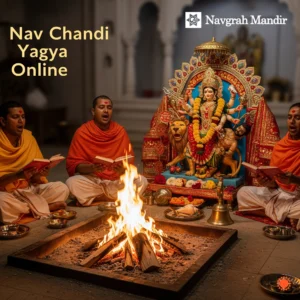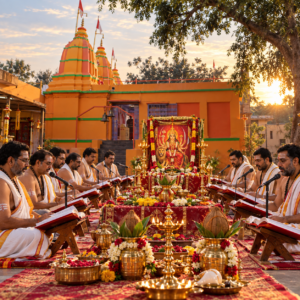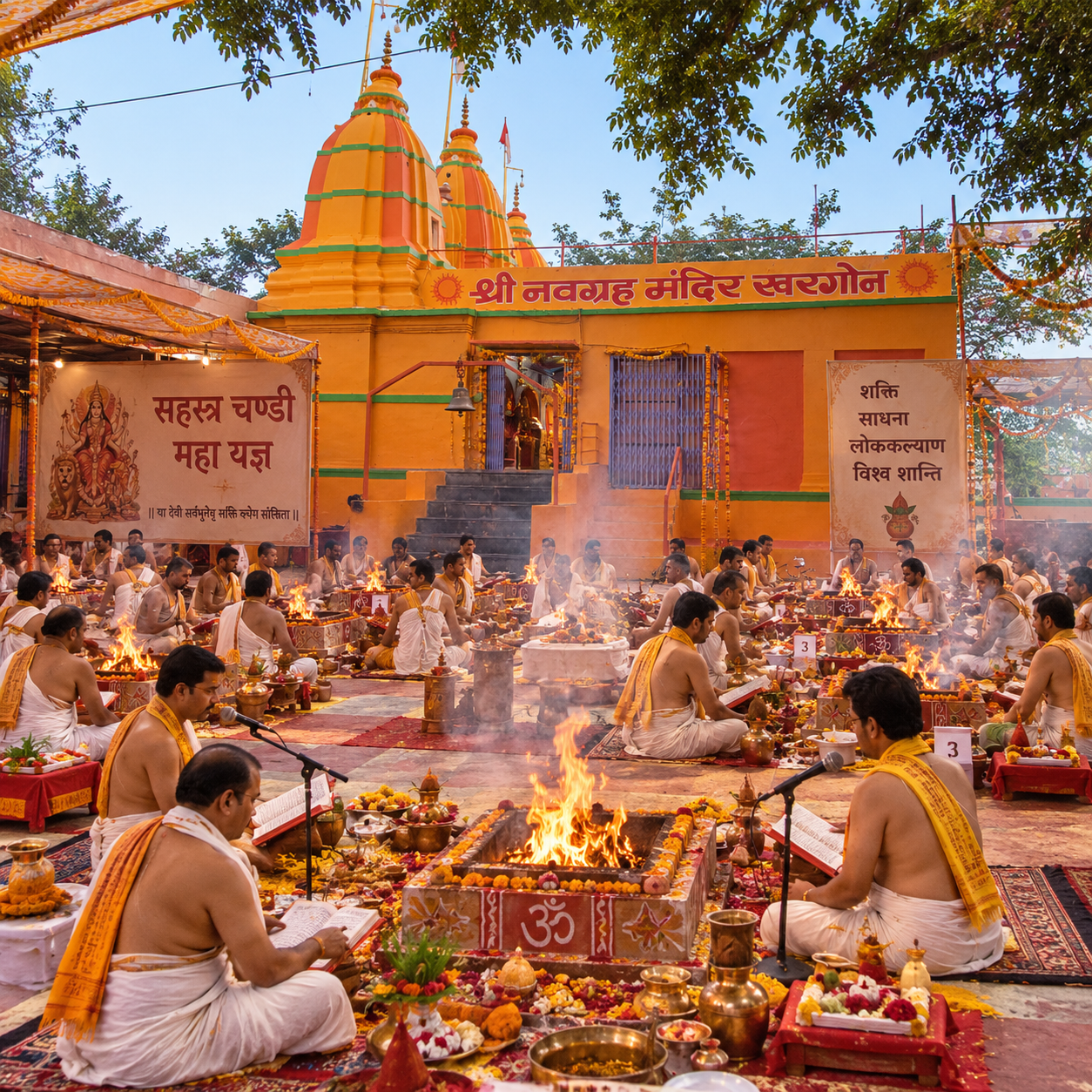
Sahasra Chandi Yagya is the recitation of the Durga Saptashati one thousand times, performed together with a yagya in which ahuti is offered for the complete thousand recitations.
At Shree Navgrah Mandir in Khargone, Madhya Pradesh, it is conducted over ten days under the guidance of Acharya Lokesh Jagirdar. Twenty pandits recite the Saptashati — five complete paths each per day — while a further four to five pandits maintain the yagya and offer ahuti throughout. You take part live in the sankalp, in the yagya, and in the concluding ashirwad puja.
What Is Sahasra Chandi Yagya?
Sahasra means one thousand. Chandi Path is the recitation of the Durga Saptashati — seven hundred verses in thirteen chapters, drawn from the Markandeya Purana and also known as Devi Mahatmya. A yagya is the accompanying fire ritual in which ahuti is offered with the mantras of the text.
Sahasra Chandi Yagya therefore combines two things: one thousand complete recitations, and a yagya offered with them under a single sankalp.
It stands at the top of the traditional ladder of Chandi observances:
| Observance | Recitations of Durga Saptashati |
|---|---|
| Durga Saptashati Path | 1 |
| Nav Chandi | 9 |
| Shat Chandi | 100 |
| Sahasra Chandi | 1,000 |
At each level, the observance may be performed as a path alone or together with a yagya. This page describes the fullest form the temple offers.
A Yagya for the Full Thousand Recitations
This is the point on which Sahasra Chandi Yagya services differ most, and it is worth understanding before you compare providers.
In common practice, the yagya accompanying a Sahasra Chandi anushthan is performed as a dashamsha — ahuti offered for a tenth of the recitations. For one thousand paths, that means a homam covering one hundred, generally conducted over the closing days.
At Shree Navgrah Mandir the yagya is performed for the full one thousand recitations, continuing across all ten days of the anushthan.
The fire is maintained and ahuti offered throughout the anushthan rather than concentrated into a concluding homam. This is a substantially larger undertaking in duration, staffing and samagri, and it is the principal reason this service is arranged and priced as it is.
When comparing providers, ask directly whether the yagya is dashamsha or for the full count. The two are frequently described in identical language.
How the Anushthan Is Staffed
The arithmetic is stated openly, because it is what you are commissioning.
| Reciting pandits | 20 |
| Recitations per pandit per day | 5 |
| Days | 10 |
| Total recitations | 1,000 |
| Pandits performing ahuti at the yagya | 4–5 |
| Total pandits | 24–25 |
Each reciting pandit recites for approximately a full day. Recitation pace varies between individuals, so the temple does not publish a fixed hourly schedule it cannot hold to.
Ask any other provider for the same figures. The total of one thousand is fixed by tradition; the staffing and duration that reach it are a matter of arrangement, and a provider who cannot state theirs is worth a second question.
A Schedule Arranged Around You
The thousand recitations and the yagya are fixed. How they are distributed is not.
If you need the anushthan completed in fewer days, the number of pandits is increased. If you would prefer it observed over a longer period, a smaller team recites across more days. The schedule is settled with Acharya ji, who will keep it within what the discipline of an anushthan and the maintenance of the yagya genuinely support.
What the Sahasra Chandi Maha Yagya Includes
Because of its scale, this observance is also known as Sahasra Chandi Maha Yagya. Beyond the recitation and the yagya itself, it includes:
- Maha Puja performed through the anushthan
- Yagya mandals — all mandals created, with their sthapana and puja
- Pradhan Devata sthapana — installation of Goddess Durga as the presiding deity, with pujan, abhisheka and offerings
- Kalash sthapana on every day of the anushthan
- Sankalp puja on the opening day, with live participation
- Daily puja throughout
- Brahmin bhojan or falahar offered once daily
- Ashirwad puja on the concluding day, with live participation
How the Anushthan Proceeds
- Day one — sankalp puja. The sankalp is performed with your name, gotra and stated intention, establishing the purpose under which the entire anushthan is offered. You participate live.
- Sthapana. The yagya mandals are created and installed with their puja. Goddess Durga is installed as Pradhan Devata with pujan, abhisheka and offerings.
- Daily kalash sthapana and puja. Performed on each day of the anushthan.
- Recitation. Twenty pandits recite the Durga Saptashati, five complete paths each per day.
- Yagya. Four to five pandits maintain the yagya and offer ahuti for the full thousand recitations, continuing across all ten days. You may join the yagya live.
- Brahmin bhojan. Offered once daily throughout.
- Concluding day — purnahuti and ashirwad puja. The yagya concludes with the final purnahuti, followed by the ashirwad puja, with you participating live.
Ritual procedure varies between traditions and lineages. The sequence above is the practice followed at Shree Navgrah Mandir, whose priestly lineage has served this temple for more than 230 years.
Samput is not included. This is performed as a standard Sahasra Chandi Yagya. Samputit recitation — where a beej mantra is interposed between verses — is offered separately. Establish whether a provider’s quotation includes samput before comparing prices.
Traditional Significance
Within the Shakta tradition, sustained recitation of the Durga Saptashati under a single sankalp is regarded as a form of tapasya, with the merit understood to arise from the continuity and discipline of the observance. Where the recitation is accompanied by a yagya, the mantras are offered into the fire alongside the recitation.
Navratri, both Chaitra and Shardiya, is traditionally regarded as the most auspicious period for Chandi observances. The anushthan may be undertaken at other times, with the start date fixed in consultation with Acharya ji.
An observance of this scale has traditionally been undertaken at moments of real significance — as a family observance carried out once in a generation, or before an undertaking of lasting consequence.
Why Devotees Undertake Sahasra Chandi Yagya
Traditionally, this anushthan is undertaken seeking:
- The Devi’s protection over a family or household
- Steadiness through a sustained and difficult period
- Spiritual merit through a major observance
- The fulfilment of a sankalp held with particular seriousness
These are traditional associations, not assured outcomes. Shree Navgrah Mandir makes no promise of any specific worldly, financial, legal, medical or personal result from this or any ritual, and no ritual should be treated as a substitute for medical treatment or professional advice.
If you are considering this anushthan in response to a severe difficulty, speak with Acharya ji before committing. He will advise you honestly, including recommending a smaller observance where that is more appropriate. The temple does not encourage anyone to undertake an observance beyond their means.
Who May Consider This Anushthan
Sahasra Chandi Yagya is the largest observance the temple performs, in scale and in cost. It is generally considered by:
- Families undertaking a major observance together, often once in a generation
- Devotees who have previously performed Shat Chandi or Sahasra Chandi Path and wish to undertake the fullest form
- Those marking an occasion of lasting family significance
- Devotees abroad who wish a large-scale ritual performed in an established temple in their own tradition
If you are undertaking a Chandi observance for the first time, consider the nine-day Durga Saptashati Anushthan, Shat Chandi Path, or Sahasra Chandi Path first. Acharya ji will help you judge which fits your intention.
Participating from Anywhere
You do not need to travel to Khargone. The anushthan is performed at the temple on your behalf, and you take part live at its principal moments.
The sankalp on day one is conducted live over WhatsApp video call, or another platform if you prefer, so you are present as your name, gotra and sankalp are spoken.
The yagya may be joined live, so you can be present as ahuti is offered.
The purnahuti and ashirwad puja on the concluding day are conducted live with you present.
Video clips and photographs of the sankalp puja are shared with you afterwards. Devotees outside India take part at times arranged to work across time zones.
Sankalp and Personalisation
The entire anushthan is performed under your personal sankalp. The thousand recitations and the yagya are offered under your stated intention, not as a general observance.
After the arrangement is confirmed, the temple contacts you on WhatsApp to collect the name or names of the devotees, gotra, and the intention. If you do not know your gotra, Acharya ji will guide you; tradition provides for this, and it is a common question.
These details are used only for the performance of the ritual. The temple does not publish or share devotee details.
Dakshina
₹20,00,000 for the standard arrangement — twenty reciting pandits and four to five pandits at the yagya, over ten days.
This covers the dakshina for all pandits, the yagya samagri for ten days of fire ritual, the mandal and kalash sthapana, the Pradhan Devata sthapana, pujan and abhisheka, the daily puja, the daily Brahmin bhojan or falahar, and the concluding purnahuti and ashirwad puja.
Where the schedule is altered, the dakshina is confirmed at the time of planning. Prasad dispatch is optional and charged separately.
Most providers of this ritual publish no figure at all. Ours is stated so you can consider it properly before enquiring — and so you can ask others what their quotation actually covers.
How to Book Sahasra Chandi Yagya Online
Because the arrangement is planned individually, Sahasra Chandi Yagya begins with a conversation.
- Contact the temple to discuss your intention, preferred timing, and schedule.
- The arrangement is confirmed — pandits, days, start date, and dakshina.
- Complete the booking. Payment can be made online, with support for Indian and international cards, or the temple can share payment details over WhatsApp.
- Sankalp details are collected over WhatsApp.
- You join the live sankalp on the opening day.
- You join the yagya live during the anushthan.
- You join the live purnahuti and ashirwad puja on the concluding day.
- Prasad is dispatched afterwards, if selected.
Enquire about Sahasra Chandi Yagya — Message us on WhatsApp
Why Shree Navgrah Mandir
The yagya is for the full thousand, not a tenth. Ten days of fire ritual alongside the recitation, rather than a concluding dashamsha homam. This is the difference most worth asking every provider about.
The arithmetic is stated. Twenty reciting pandits, five paths each per day, ten days, plus four to five pandits at the yagya. You can check it.
A temple, not a booking platform. Performed at Shree Navgrah Mandir in Khargone, under an Acharya whose family founded the temple and has served it for more than 230 years.
You can watch the yagya. Not only the sankalp and the closing puja — the fire ritual itself.
The dakshina is published, and what it covers is itemised.
We say what is not included. Samput is a separate service, and this page says so.
We will recommend a smaller observance where that is right. Acharya ji would rather you perform the appropriate anushthan than the largest one.
Related Chandi Observances
- Sahasra Chandi Path — the same 1,000 recitations, without the yagya
- Shat Chandi Path — 100 recitations
- Durga Saptashati Anushthan — nine days, concluding with yagya and purnahuti
Frequently Asked Questions
What is Sahasra Chandi Yagya? One thousand recitations of the Durga Saptashati performed together with a yagya, under a single sankalp, over ten days.
Is the yagya performed for all thousand recitations, or a tenth? For the full thousand. The yagya runs across all ten days of the anushthan rather than being concentrated into a concluding dashamsha homam. This is a larger undertaking than the common arrangement and is the main reason for the scale and dakshina of this service.
How many pandits perform it? Twenty pandits recite the Durga Saptashati, five complete paths each per day. A further four to five pandits maintain the yagya and offer ahuti — twenty-four to twenty-five in total.
How are one thousand recitations possible in ten days? Through recitation in parallel: 20 pandits × 5 recitations per day × 10 days = 1,000.
Can it be completed in fewer days? Yes. The number of pandits is increased to compress the schedule, or a smaller team recites over a longer period. The total never changes.
What is the difference between Sahasra Chandi Path and Sahasra Chandi Yagya? Sahasra Chandi Path is the thousand recitations alone. Sahasra Chandi Yagya adds the yagya, the mandal and kalash sthapana, the Pradhan Devata sthapana with pujan and abhisheka, and the concluding purnahuti.
Why is it also called Sahasra Chandi Maha Yagya? Because of its scale — the number of pandits, the ten-day yagya, and the full arrangement of mandals and sthapana.
Can I watch the yagya live? Yes. The sankalp, the yagya, and the concluding purnahuti and ashirwad puja are all conducted with your live participation.
Do I need to travel to Khargone? No. The anushthan is performed at the temple on your behalf, with live participation over a video call.
What is the dakshina? ₹20,00,000 for the standard arrangement. If the schedule differs, it is confirmed during planning. Prasad dispatch is charged separately.
What does the dakshina cover? Dakshina for all pandits, yagya samagri for ten days, mandal and kalash sthapana, Pradhan Devata sthapana with pujan and abhisheka, daily puja, daily Brahmin bhojan or falahar, and the concluding purnahuti and ashirwad puja.
Is samput included? No. Samputit recitation is offered as a separate service.
Is Brahmin bhojan included? Yes, once daily throughout the anushthan.
What details do you need from me? Name or names of the devotees, gotra, and your sankalp — collected over WhatsApp.
I do not know my gotra. Can I still book? Yes. Tradition provides for this and Acharya ji will guide you.
When should it be performed? Navratri is traditionally regarded as most auspicious, but it may be undertaken at other times. Start dates are fixed with Acharya ji.
Can I book from outside India? Yes. International payment is supported and live participation is arranged across time zones.
Will this guarantee a particular result? No. It is traditionally undertaken seeking the Devi’s protection and grace. Shree Navgrah Mandir makes no promise of any specific outcome.
Enquire About Sahasra Chandi Yagya
One thousand recitations of the Durga Saptashati with a yagya offered across all ten days, performed at Shree Navgrah Mandir under your personal sankalp by Acharya Lokesh Jagirdar and his pandits.
Dakshina: ₹20,00,000 for the standard arrangement. Schedule arranged around your timing.
Enquire Now — Message us on WhatsApp
Performed and reviewed by Acharya Lokesh Jagirdar, Priest, Shree Navgrah Mandir, Khargone (M.P.). Sixth generation of a family that founded the temple and has served it for more than 230 years. More than 26 years of practice in Vedic astrology and karmakand.