Table of Contents
ToggleComplete Guide to Ashadha Gupt Navratri 2026 with Day-wise Calendar, Vedic Significance, Pitambara Devi Worship & Online Puja Booking
Ashadha Gupt Navratri is one of the most spiritually significant yet lesser-known festivals in Sanatan Dharma. Unlike the widely celebrated Chaitra and Sharadiya Navratri, which are marked by public celebrations, cultural programs, and large gatherings, Gupt Navratri is traditionally observed with deep spiritual discipline, mantra japa, Devi worship, fasting, self-purification, and dedicated sadhana.
The word “Gupt” means hidden, secret, or inward. This does not imply secrecy in the sense of concealment, but rather emphasises inner spiritual practice over external celebration. During these sacred nine nights, devotees withdraw from worldly distractions and dedicate themselves to sincere worship of the Divine Mother in Her various manifestations.
For seekers of spiritual progress, Ashadha Gupt Navratri is regarded as one of the most auspicious periods of the year. It is especially valued by devotees who wish to strengthen their devotion to the Divine Mother through regular worship, mantra recitation, scriptural study, charity, and disciplined living.
At Shree Navgrah Mandir, Ashadha Gupt Navratri has a unique spiritual significance because of the temple’s Pitambara Grah Shanti Peeth, where Goddess Baglamukhi is worshipped through authentic Vedic traditions. Throughout these nine sacred days, devotees from India and abroad participate in Baglamukhi Puja, Baglamukhi Havan, 9-Day Baglamukhi Anushthan, Durga Puja, Durga Saptashati Path, and other Devi-related Vedic rituals, with the option of participating online through live telecast.
Ashadha Gupt Navratri 2026 Dates
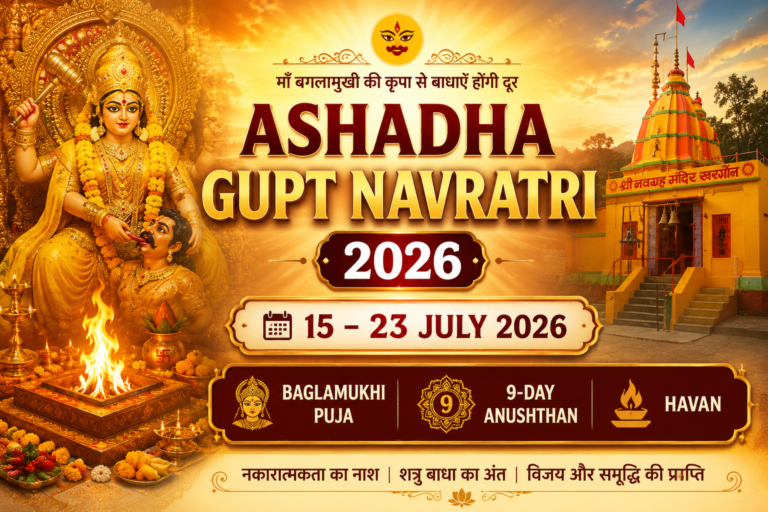
Ashadha Gupt Navratri in 2026 will begin on Wednesday, 15 July 2026, and conclude on Thursday, 23 July 2026.
These nine days are dedicated to the worship of the Divine Mother in Her nine principal manifestations (Navadurga), while many spiritual traditions also consider this period highly suitable for the worship of Mahavidya forms, particularly Goddess Baglamukhi.
Ghatasthapana
Date: Wednesday, 15 July 2026
Ghatasthapana, also known as Kalash Sthapana, marks the formal commencement of Navratri. The Kalash symbolises divine consciousness, abundance, purity, and the presence of Adi Shakti within the home or temple.
Sandhi Puja
Date: Wednesday, 22 July 2026
Timing: 04:52 AM – 05:40 AM
Sandhi Puja marks the sacred junction between two powerful phases of Navratri and is regarded as one of the holiest periods for Devi worship.
Navratri Parana
Date: Thursday, 23 July 2026
Devotees observing the Navratri Vrat traditionally complete their observance after the prescribed Parana time on Navami.
Day-wise Ashadha Gupt Navratri 2026 Calendar
| Day | Date | Tithi | Worship |
|---|---|---|---|
| Day 1 | 15 July 2026 | Pratipada | Ghatasthapana & Maa Shailputri Puja |
| Day 2 | 16 July 2026 | Dwitiya | Maa Brahmacharini Puja |
| Day 3 | 17 July 2026 | Tritiya | Maa Chandraghanta & Maa Kushmanda Puja |
| Day 4 | 18 July 2026 | Panchami | Maa Skandamata Puja |
| Day 5 | 19 July 2026 | Shashthi | Maa Katyayani Puja |
| Day 6 | 20 July 2026 | Saptami | Maa Kalaratri Puja |
| Day 7 | 21 July 2026 | Ashtami | Durga Ashtami & Maa Mahagauri Puja |
| Day 8 | 22 July 2026 | Navami | Sandhi Puja & Maa Siddhidatri Puja |
| Day 9 | 23 July 2026 | Navami | Navratri Parana |
What is Ashadha Gupt Navratri?
Many devotees know only the two widely celebrated Navratris—Chaitra Navratri and Sharadiya Navratri. However, according to the Hindu lunar calendar, there are four Navratris observed each year:
- Chaitra Navratri
- Ashadha Gupt Navratri
- Magha Gupt Navratri
- Sharadiya Navratri
Among these, Ashadha and Magha Navratri are collectively known as Gupt Navratri because the emphasis is placed on quiet devotion, personal spiritual discipline, mantra japa, scriptural recitation, and Devi Upasana, rather than large public festivities.
In many traditions, Ashadha Gupt Navratri is also referred to as Gayatri Navratri, as devotees dedicate themselves to the worship of Goddess Gayatri and the recitation of the Gayatri Mantra during these nine days.
Scriptural Significance of Gupt Navratri
The worship of the Divine Mother during Navratri is praised in several Hindu scriptures, including the Markandeya Purana, which contains the revered Devi Mahatmya (Durga Saptashati), and the Devi Bhagavata Purana, which elaborates on the glory of Adi Shakti.
A celebrated verse from the Devi Mahatmya declares:
या देवी सर्वभूतेषु शक्तिरूपेण संस्थिता।
नमस्तस्यै नमस्तस्यै नमस्तस्यै नमो नमः॥
Meaning: Salutations again and again to the Divine Goddess who resides in all beings in the form of Shakti.
This verse reminds devotees that the Divine Mother is present in every aspect of creation—as strength, wisdom, compassion, courage, and divine consciousness.
Gupt Navratri provides an opportunity to reconnect with this inner Shakti through sincere devotion and disciplined spiritual practice.
Why Ashadha Gupt Navratri is Spiritually Powerful
Ashadha falls during the onset of the monsoon season across much of India. Traditionally, this period marks a gradual transition from outward activity to deeper contemplation. Ancient sages regarded it as an ideal time to reduce worldly distractions and increase spiritual practices such as:
- Daily mantra japa
- Meditation
- Reading sacred scriptures
- Charity (Daana)
- Fasting (Vrat)
- Worship of the Divine Mother
Unlike festivals centred primarily on celebration, Gupt Navratri encourages inner transformation. It is a time to cultivate humility, self-control, devotion, and faith.
Many devotees undertake personal spiritual resolutions (Sankalpa) during these nine days, praying for strength to overcome fear, confusion, obstacles, and negativity while seeking divine guidance in their lives.
Why Goddess Baglamukhi Holds Special Importance During Gupt Navratri
Among the many forms of the Divine Mother, Goddess Baglamukhi occupies a unique and revered position in the Shakta tradition. She is worshipped as Pitambara Devi, the golden-hued Goddess who symbolises divine protection, unwavering resolve, and the power to overcome obstacles through righteousness.
At Shree Navgrah Mandir, Khargone, devotees worship Goddess Baglamukhi through pure Vedic rituals. The temple does not promote or perform Tantric practices. Instead, worship is rooted in Vedic mantras, traditional puja procedures, havan, and scripturally guided anushthans performed by experienced priests.
For this reason, Ashadha Gupt Navratri has become one of the most important periods at the temple for devotees who wish to seek the blessings of Pitambara Devi through authentic Vedic worship.
Why Devotees Worship Goddess Baglamukhi During Ashadha Gupt Navratri
In the tradition followed at Shree Navgrah Mandir, Ashadha Gupt Navratri is regarded as one of the most auspicious periods for worshipping Goddess Baglamukhi, also revered as Pitambara Devi.
The word “Pitambara” means “She who is adorned in yellow garments.” The colour yellow symbolises:
- Divine knowledge
- Auspiciousness
- Prosperity
- Confidence
- Purity
- Spiritual illumination
Baglamukhi Devi is revered as the Goddess who grants protection, courage, righteous victory, clarity of speech, mental steadiness, and the strength to overcome obstacles. Devotees pray to Her not merely for worldly success, but for the wisdom and inner strength to face life’s challenges with faith and discipline.
During Gupt Navratri, many devotees undertake a special Sankalpa (spiritual resolve) to dedicate these nine days to sincere worship of the Divine Mother. The emphasis is on devotion, mantra recitation, charity, self-discipline, and righteous living.
Ashadha Gupt Navratri at Shree Navgrah Mandir, Khargone
Ashadha Gupt Navratri is one of the major Devi festivals observed at Shree Navgrah Mandir, Khargone.
The temple is home to Pitambara Grah Shanti Peeth, where Goddess Baglamukhi is worshipped according to authentic Vedic traditions.
Unlike many places where public festivities dominate Navratri celebrations, the focus here remains on:
- Individual Sankalpa
- Vedic mantra chanting
- Devi Upasana
- Sacred Havan
- Scriptural recitation
- Personal spiritual discipline
Each devotee’s worship is performed individually according to the Sankalpa taken in their name.
Recommended Worship During Ashadha Gupt Navratri 2026
The following Vedic rituals are especially recommended during these nine sacred days:
🌼 Baglamukhi Puja
A traditional Vedic worship dedicated to Goddess Baglamukhi, performed with devotion and prescribed mantras for divine blessings, protection, confidence, and spiritual strength.
🔱 9-Day Baglamukhi Anushthan
For devotees wishing to observe the complete Navratri spiritually, a nine-day Baglamukhi Anushthan is one of the most meaningful observances.
The Anushthan spans the entire Navratri period and is performed with daily worship according to Vedic traditions.
🔥 Baglamukhi Havan (Yagya)
Havan occupies an important place in Vedic worship.
During Ashadha Gupt Navratri, many devotees choose to perform a Baglamukhi Havan while praying for:
- Removal of obstacles
- Mental peace
- Stability
- Confidence
- Prosperity
- Family well-being
🌺 Durga Puja
Although Baglamukhi worship remains the primary focus at the temple during Gupt Navratri, devotees also participate in traditional Durga Puja to seek the blessings of Adi Shakti in Her universal form.
📖 Durga Saptashati Path
The recitation of the Durga Saptashati (Devi Mahatmya) is one of the most sacred practices of Navratri.
This scripture narrates the victories of the Divine Mother over various forms of adharma and symbolises the triumph of righteousness over negativity.
🌼 Chandi Path
Many devotees also undertake Chandi Path during Navratri as an act of devotion and reverence toward the Divine Mother.
🌸 Navadurga Puja
Throughout the nine days, devotees worship the nine forms of the Divine Mother represented by the Navadurga.
The Nine Forms of the Goddess Worshipped During Navratri
Although Gupt Navratri is associated with deeper spiritual practices, the worship of Navadurga remains central to the observance.
Day 1 – Maa Shailputri
Shailputri represents stability, determination, and the beginning of the spiritual journey.
She teaches devotees to build a strong foundation of faith.
Day 2 – Maa Brahmacharini
She symbolises discipline, austerity, knowledge, and unwavering devotion.
Her worship inspires perseverance and inner strength.
Day 3 – Maa Chandraghanta
Maa Chandraghanta is worshipped for courage, fearlessness, and protection.
She reminds devotees to remain calm even during adversity.
Day 4 – Maa Kushmanda
She represents creative energy and the life-giving force of the universe.
Her blessings are associated with vitality, positivity, and abundance.
Day 5 – Maa Skandamata
The compassionate Mother of Lord Kartikeya symbolises maternal love, wisdom, and divine grace.
Day 6 – Maa Katyayani
Maa Katyayani represents righteous strength and determination.
She inspires devotees to overcome difficulties through courage and devotion.
Day 7 – Maa Kalaratri
Despite her fierce appearance, Maa Kalaratri is regarded as the remover of fear and ignorance.
She protects sincere devotees and guides them toward spiritual light.
Day 8 – Maa Mahagauri
Mahagauri symbolises purity, forgiveness, serenity, and inner peace.
Her worship is believed to bring harmony and auspiciousness.
Day 9 – Maa Siddhidatri
The final form of Navadurga is Siddhidatri, the giver of spiritual accomplishments and divine blessings.
She represents the culmination of the devotee’s spiritual journey during Navratri.
What Should Devotees Do During Ashadha Gupt Navratri?
The following practices are traditionally encouraged:
- Wake up early during Brahma Muhurta
- Maintain personal cleanliness and purity
- Offer prayers to the Divine Mother daily
- Light a ghee lamp before the deity
- Chant Devi mantras with devotion
- Read sacred scriptures such as the Durga Saptashati
- Practice charity according to one’s capacity
- Maintain truthfulness, humility, and self-discipline
- Consume sattvic food if observing a vrat
- Spend time in prayer, meditation, and self-reflection
The purpose of these practices is not merely ritual observance but the cultivation of devotion, inner peace, and righteous living.
What Should Be Avoided During Gupt Navratri?
Many devotees also observe certain disciplines during these nine days, such as:
- Avoiding anger and harsh speech
- Avoiding intoxicants
- Avoiding violence or harm toward living beings
- Avoiding tamasic food
- Avoiding unnecessary conflicts
- Avoiding dishonesty and unethical conduct
The essence of Gupt Navratri lies in purifying both actions and thoughts.
Benefits of Observing Ashadha Gupt Navratri
According to traditional belief, sincere observance of Gupt Navratri helps devotees cultivate:
- Stronger devotion toward the Divine Mother
- Mental peace
- Self-confidence
- Emotional balance
- Positive thinking
- Family harmony
- Spiritual progress
- Inner resilience during life’s challenges
While many devotees also pray for prosperity, health, career growth, or success, the highest objective of Navratri remains spiritual refinement and closeness to the Divine.
Why Thousands of Devotees Participate Online
Today, many devotees are unable to travel because of work, studies, age, or health.
To help them participate, Shree Navgrah Mandir offers:
- Individual Sankalpa
- Personalised Vedic Puja
- Live telecast of rituals
- Online participation from anywhere in the world
- Prasad dispatch (where applicable)
This allows devotees to remain connected with the temple’s worship while observing Gupt Navratri from their homes.
Frequently Asked Questions (FAQs) – Ashadha Gupt Navratri 2026
1. When is Ashadha Gupt Navratri in 2026?
Ashadha Gupt Navratri will be observed from 15 July 2026 (Wednesday) to 23 July 2026 (Thursday).
2. Why is it called Gupt Navratri?
The Sanskrit word “Gupt” means hidden or inner. Unlike Chaitra and Sharadiya Navratri, Gupt Navratri emphasises personal spiritual discipline, mantra japa, Devi worship, meditation, and inward devotion rather than large public celebrations.
3. Is Ashadha Gupt Navratri the same as Gayatri Navratri?
Yes. In many traditions, Ashadha Gupt Navratri is also known as Gayatri Navratri, as devotees perform Gayatri Mantra japa and worship Goddess Gayatri during these sacred nine days.
4. Which Goddess is most worshipped during Gupt Navratri?
All forms of the Divine Mother are worshipped during Gupt Navratri through the Navadurga tradition. At Shree Navgrah Mandir, special emphasis is given to the worship of Goddess Baglamukhi (Pitambara Devi) through authentic Vedic rituals.
5. Can beginners observe Gupt Navratri?
Yes. Anyone with sincere faith can observe Gupt Navratri through:
- Daily prayer
- Fasting according to their ability
- Reading sacred scriptures
- Chanting Devi mantras
- Performing simple puja
- Charity and self-discipline
6. Which pujas are recommended during Ashadha Gupt Navratri?
The following Vedic rituals are especially recommended:
- Baglamukhi Puja
- 9-Day Baglamukhi Anushthan
- Baglamukhi Havan
- Durga Puja
- Durga Saptashati Path
- Chandi Path
- Navadurga Puja
7. Can I participate online if I cannot visit the temple?
Yes. Devotees from anywhere in the world can participate through individual online puja with live telecast, allowing them to receive the blessings of the Navratri rituals without travelling.
Celebrate Ashadha Gupt Navratri 2026 at Shree Navgrah Mandir
Ashadha Gupt Navratri is not merely a festival—it is an opportunity to deepen one’s devotion, strengthen inner resolve, and seek the blessings of the Divine Mother through sincere worship.
At Shree Navgrah Mandir, Khargone, this sacred period is observed with great reverence through Vedic rituals dedicated to Pitambara Devi (Goddess Baglamukhi) and the Navadurga.
Whether you visit the temple in person or participate online, the nine sacred days offer a meaningful opportunity to reconnect with spirituality, cultivate discipline, and pray for the well-being of yourself and your family.
Book Your Ashadha Gupt Navratri Puja 2026
🌼 Baglamukhi Puja
Seek the blessings of Pitambara Devi through authentic Vedic worship performed individually in your name.
🔱 9-Day Baglamukhi Anushthan
A complete Navratri Anushthan is performed throughout all nine days with a personalised Sankalpa.
🔥 Baglamukhi Havan (Yagya)
Participate in a sacred Vedic fire ritual dedicated to Goddess Baglamukhi during Gupt Navratri.
🌺 Durga Puja
Offer prayers to the Divine Mother during one of the holiest Navratris of the year.
📖 Durga Saptashati Path
Receive the blessings of Adi Shakti through the recitation of the sacred Devi Mahatmya.
🌍 Online Puja with Live Telecast
✔ Individual Sankalpa
✔ Vedic Rituals
✔ Experienced Priests
✔ Live Telecast Worldwide
✔ Personalised Worship